Old Age is Not for Sissies
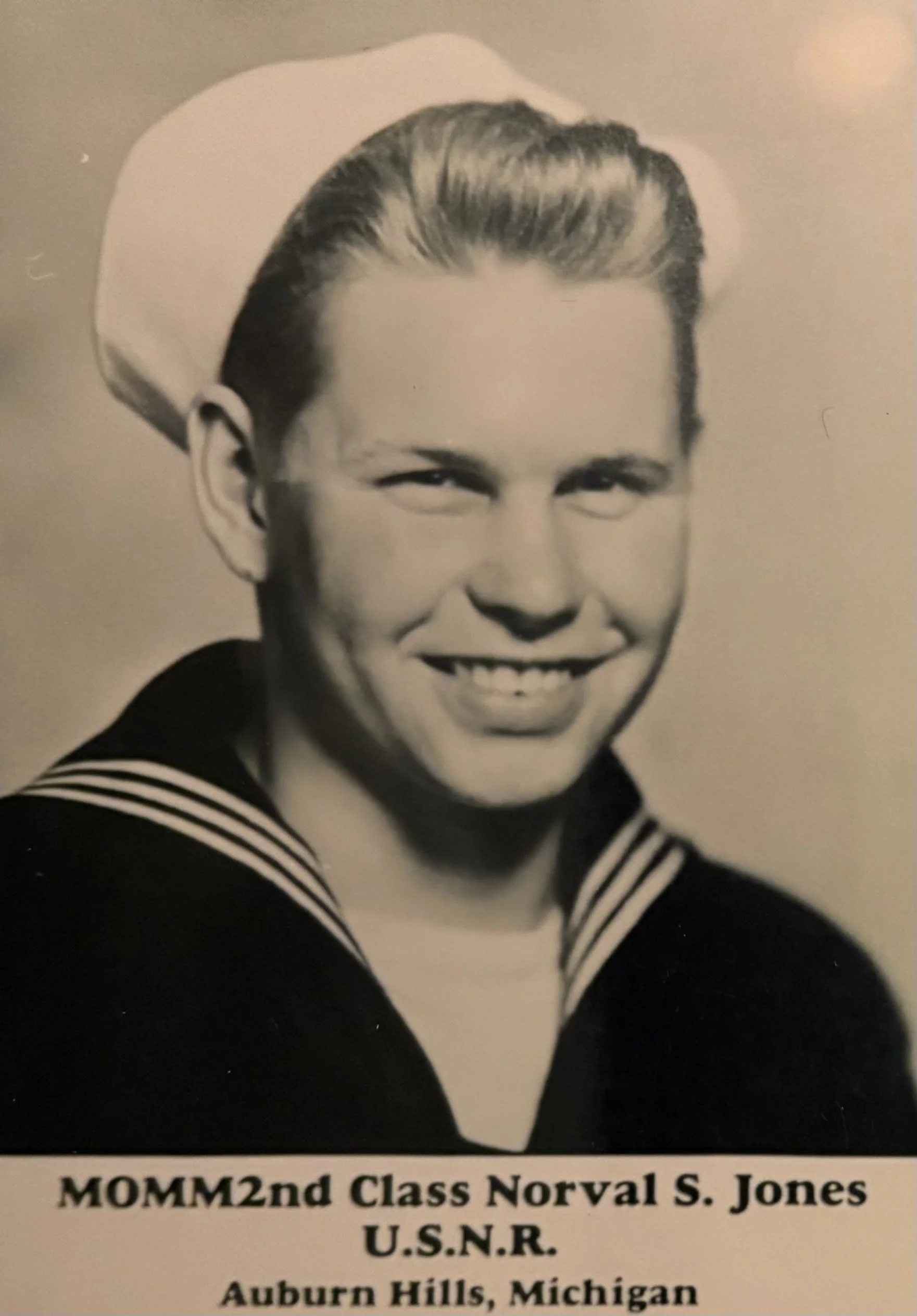
This story began as a reflection of my father-in-law’s end of life journey, his transition from treatment to comfort care, and the gentle power of hospice. It became a tribute to the man who was “Dad” to me for 25 years. A WWII veteran born before the Great Depression, he worked from a young age and lived fully giving to others. To understand the end of his life, we need to start at the beginning.
Norval Frederick Jones was born on October 10th, 1926 in Auburn Heights Michigan to Winifred and Harry Jones. He was the second of four sons and grew up during the depression. Their dad left when he and his three brothers were very young.
At just nine years old, Norval began providing for his family. He was the only sibling who would go off willingly every summer at their mom’s request, driven by the knowledge that they needed the money to survive. He was sent to live on a farm, where he spent his days picking potatoes for five cents a day, and his nights sharing a bed with the farmer. By age twelve he was driving a truck working at a local gravel pit.
From a generation of “can-doers,” Norv was too poor to have a bicycle growing up, so he built his own out of parts salvaged from the junkyard. His mom could not afford to buy coffee so they gathered wild chicory root from roadside ditches, then roasted and boiled it to create their own.
When the war broke out, Norval was only seventeen so his mom signed papers for him to join the Navy. He sent his wages home and used his sewing skills to earn extra money by altering uniforms for his fellow sailors. Stationed on an LST as a diesel mechanic, he spent most of the war in the South Pacific. Norv often joked about the abbreviation LST; the letters stood for “Landing Ship Tank” but everyone on board knew them as “Large Slow Targets." They felt like sitting ducks whenever they came under enemy fire.
He had many incredible stories to tell. While in Hawaii recovering from an illness, a circus arrived to entertain the troops, featuring a roller-skating bear. After the performance, Norv was allowed to skate with the large bear towering over him while they glided around the rink.
After the war ended, Norval and Margaret married. They were childhood sweethearts, she was eleven and he was thirteen. They met while rollerskating in a house nearby where local kids gathered. He walked her home often, and on occasion, was invited to stay for dinner. Norval claimed Margaret’s mom made the best fried chicken he ever had.
Early in their marriage he was caretaker of a dairy farm on Featherstone Road called the Seyburne estate. He milked 80 cows twice daily with an automatic milking system for years. His sons spent a great deal of their childhood playing on the 1200 acres of pasture, old growth forest, creeks and trails.
They had three boys, their eldest, Stevie, died at age three from an aggressive eye cancer. It was an unimaginable heartbreak, one they endured together. Norv was too poor to join boy scouts as a youngster, so he became active as a scout leader when his sons Bart and Darrin were growing up.
Norval held multiple jobs, primarily as janitor for Avondale schools. He also cleaned their church weekly, was a volunteer fireman, captain of the fire department, and taught first aid and CPR classes for decades. He was an active WWII veteran.
He could fix anything. Once he welded the bed of an old pickup truck to make a back end for their family station wagon. The Edsel engine and front seats were fine, but the wagon’s rear had been damaged beyond repair. Norv loved to laugh about the confusion he caused at the Secretary of State’s office when he went to apply for the registration. He built a one of a kind vehicle and called it an "Edsel pickup."
In the mid-70’s after a house in Auburn Heights blew up, the mother and son moved in with the Joneses for weeks while their home was restored. Norv and Margaret always helped others in need, family, friends, neighbors and strangers alike.
Norval survived a heart attack and open-heart surgery in 1984, followed by a second major heart surgery in 1997. He often said the last twenty years of his life were the gift of modern medicine.
In August 2000, Norval joined a group of retired naval veterans on a mission to Greece to retrieve an old World War II LST. The trip was supposed to last four weeks, but turned into a grueling six months. Margaret was beside herself with worry. It was the longest they had been apart in their married life.
Prior to their arrival in Greece, the USS LST ship Memorial identified the LST-325 as the most sea worthy of vessels abandoned in a shipyard in Crete. Many had been left there after the war. Their goal was to bring the ship home to the United States and transform it into a floating museum.
The average age of sailors was 72. The crew of twenty-nine senior veterans camped on the rust bucket ship, stinking with garbage in 100 degree heat for months. Because it was sweltering below deck, they slept topside under the stars. The crew salvaged parts from derelict ships nearby. They repaired the engine, patched holes, cleaned and updated equipment until the vessel was sea worthy enough to sail her across the ocean.
In early January, I packed my sons and drove to Mobile, Alabama, for the homecoming. Margaret had left Michigan a month earlier to stay with her sisters in Florida, so we met at the hotel in Mobile where the spouses had gathered, all waiting together for the arrival.
The next morning was January 10th, 2001. The wives went on one bus, my young sons and I followed on another. When we got to the dock a brass band played patriotic tunes. There were over four thousand people in attendance. Veterans from all over the country, the mayor, and numerous dignitaries had gathered to honor these men and their extraordinary accomplishment. It was a grand celebration; no one expected such an overwhelming turnout.
The LST-325 came into view on the bay with tug boats spouting plumes of red white and blue water. I could not believe the dilapidated condition of the vessel; her hull was a patchwork of rust and dents, yet miraculously she still floated. The ship made it thousands of miles across the ocean, under her own power, guided by the hands of these senior Navy veterans. It was a sight to behold.
As the ship drew near, I watched Norval emerge from a hatch below, he was the first sailor on deck. He looked handsome in his tan uniform and trimmed white beard. I could tell he was searching for Margaret. The wives were standing close to the ship with the deck looming high above. He couldn’t see her or hear her voice over the roar of the boisterous mob.
Norv had no trouble spotting us, even from the back of the massive crowd. With my son Bowie on my shoulders, we stood over seven feet tall! Knowing how desperately he and Margaret wanted to be reunited, I began pushing toward her through the sea of people. As we moved I explained that my father-in-law, the boys’ grandpa, was the sailor on deck. Strangers in the crowd were very kind and helped us squeeze through when they realized we had family on board.
I reached Margaret, grabbed her hand and helped her up the gangplank. She was the first on board and their reunion was unforgettable; in that moment, the world around them vanished. They hugged and kissed like newlyweds while we the rest of us cheered. Their photo made the front page of several papers. It was reminiscent of the young couple reunited when the war ended in 1945.
Norval’s final journey began when he was admitted to Crittenton Hospital December 18th, 2007 his grandson Truman’s 15th birthday. Luckily we celebrated three days earlier because for the next two months, Norv would be sent back and forth from hospital to rehab several times. Wherever he went, I went with him. It was during those difficult weeks that he started calling me his "lifeline."
He was transferred to the 8th-floor ICU - semi-conscious, in pain, and with labored, audible respirations; his kidneys were shutting down. Having been with my mom and grandpa when they died, I immediately recognized the signs. Looking at the “tea-colored” urine in his Foley bag and hearing the distinctive cough, the full gravity of the situation set in.
When Margaret saw the love of her life unresponsive in the ICU bed, she climbed on the gurney, clutched him by his hospital gown and begged him not to leave her. Having shared such a close bond in their 62 years of marriage, it was heartbreaking to witness.
They were the most amazing people I had ever known; I loved them and would’ve done anything for them. Though I am not religious, I prayed that night with an intensity like never before, calling on all powers of the universe to either heal Norval or end his suffering.
Suddenly, I connected to a tunnel of golden light, pulsing with vibrant colors as though I tapped into a current of healing energy. It felt vast yet intimate; I could hear invocations whispered in many languages, like a universal prayer hotline. Whatever the outcome, I was surrounded by such profound love, calm and peace I knew in my heart everything would be okay.
The next morning as I approached the hospital room, a doctor exited scratching his head. I walked in and saw Norv sitting up in bed relaxed and talking with Margaret. His urine was now clear yellow, no more cough, distress or pain. Miraculously, he had returned from the brink of death. Norval knew Margaret needed more time with him.
So my dear father-in-law, a retired Naval veteran and the salt of the earth-was transferred from the hospital to rehab. He gathered the courage and resolve needed to get stronger in order to go home. However, during the next eight weeks, he would be sent to the hospital four times from the facility for various reasons. After growing up during the Depression and all he had been through in life Norval said more than once, “Old age is not for sissies.”
Being a patient in the modern medical system is not for the faint of heart. You are at the mercy of facility staff that hopefully are not so overburdened they ignore your care.
After his first hospital stay, Norval required 4 liters of oxygen to breathe. During a visit to one of his physical therapy sessions, I found him in his wheel chair huffing and puffing as he struggled to exercise. I discovered his tank was empty. Immediately I alerted staff and the situation was corrected, but the importance of advocating for those you love cannot be overstated. This was one of several instances when I understood why he called me his “life line.”
Back and forth he went from hospital to rehab, rehab to hospital. All the while Norv kept asking to go home. Margaret, Bart and I encouraged him to get stronger according to the plan. It wasn't until his final hospital admission that Dr. Reddi, Norv’s cardiologist of 20 years, sat us down for a literal heart-to-heart conversation.
He explained that the only thing keeping Norval alive was his pacemaker; no other treatment would cure him. It was time to call hospice. This news was incredibly sad, yet simultaneously, it brought a profound sense of relief. Dr. Reddi gave us permission to be okay with the fact that we didn’t have to push him to get stronger anymore. It was alright; we understood. Norval would get his wish to go home, where he would eventually die.
The next day I went back to the hospital and Norv was not in his room. During the night, a pulmonologist doing rounds saw him and said “I can treat him.” He was transferred back to the ICU.
This unexpected turn caused stress and doubt about our decision for hospice. Medications and interventions could continue, but would not cure nor give him quality of life. It was time to focus on Norval as a person, not labs, test results or numbers. His deepest wish was to be in his own home, surrounded by family to enjoy the time he had left.
Doctors are trained to heal, but far too many lack the education to recognize when a patient is nearing the end of life. Norval’s pulmonologist failed to see the bigger picture - the exhausting, hospital rehab cycle with no end in sight. When your loved one’s illness is incurable and they no longer wish to be poked and prodded, or when the risk of treatment begins to outweigh the benefit, it is time to discuss end of life care.
With the gift of modern medicine we have forgotten that dying is not a medical problem to be solved. Death is a biological function, a profound social and cultural event. Our bodies were designed to die just as they were designed to be born; they instinctively know how with little intervention from us. The goal at the end of life is keep your loved one safe and comfortable as they traverse this final process.
I was not a nurse at the time, so I knew little about end-stage congestive heart disease. Without a medical background, I viewed the situation as a daughter wanting her father-in-law to get better. We often project our hopes and desires onto our loved ones, assuming to know what’s best for them, and that is not always the case. The hospital and rehab staff encourage this too as their goal is to get the patient stable for discharge.
Looking back now the big clue was that Norv kept asking to go home. He never said “I know I’m dying and I want no further treatment”; he was too stoic for that, and he knew hearing those words would’ve broken Margaret’s heart. Dr. Reddi talked with Norv privately before he talked with us, so we knew the decision had already been made - it was unspoken, but deeply implied.
We were grateful that Dr. Reddi—a physician Norval trusted and we respected—was honest enough to tell us the truth: nothing more could be done. Otherwise we would have continued medical interventions; unaware of the gravity of his illness, and the futility of treatment that offered no hope of recovery.
While I coordinated with the hospital and hospice to have the equipment delivered and discharge finalized, Margaret had one objection. Norv’s brothers from the fire department wanted to bring him home themselves as a final expression of honor and respect for their former captain. Margaret did not want this as she knew them all so well, the thought was too painful for her to bear.
We both cried as I explained they needed to do this for Norval— it was their way of honoring the man who dedicated his life to helping others. She reluctantly agreed, and the men who had fought fires and rescued people alongside Norval for decades brought him home by ambulance. They carried him through his front door under a dark, starry night. Many tears were shed; it was a somber, sacred moment of the brotherhood taking care of their own.
Norv was so relieved to be home. The hospice nurse came, we made him comfortable in his bed set up in the front room for the night. I asked if he was happy to be home, he sighed and said “oh yeah!”
His transition was rapid. By the next day he was no longer able to eat or drink, requiring only occasional morphine to help with breathing. Norv had no pain. We placed his bed near the window where he could see the falling snow.
The hospice chaplain was a true angel. She spoke with comforting enthusiasm about the transitioning process and when the time came, she alerted us with a sense of wonder to the mottling of his skin. Death was imminent.
We gathered around him, holding hands as the minister prayed. Norv’s spirit left his body and seemed to gently float around the room; he appeared to thoroughly enjoy this new-found freedom. With his wish fulfilled to be home, he had a peaceful death surrounded by loved ones.
As Norv took his last breath, friends parked in the driveway and watched a squirrel jump on to the edge of Bart’s plow. It sat there, looking directly at them, and gave a tiny wave of its paw before scurrying away. The behavior was so unusual they knew instinctively it was a sign from Norval. When they came to the door and we told them Norv had died a moment ago, it confirmed what they already felt: the squirrel was his way of saying goodbye.
Due to a major snow storm, Norval’s body remained at home for several hours. Encouraged by the hospice chaplain, Margaret was able to sit with him—a sacred window of time to say her final goodbyes. Having the space she needed was a vital part of her grieving process.
When the funeral home finally arrived to remove his body, Margaret was left cold, numb, and in a state of shock. I made her hot tea with honey and heated a large fleece blanket in the dryer, wrapping her in its warmth for comfort. Norv told me to take care of her after he died and I intended to honor that promise.
Norval was a wonderful man-a pillar of support for his family and a true role model in the community. Looking back on his final months, it is now clear how easily we became so focused on the cycle of treatments that we temporarily lost sight of his true wishes. We were unaware of the subtle signs that indicated he was dying until his physician finally spoke the truth.
If you find yourself in a similar situation and your doctor seems hesitant to discuss the end of life, do not wait—request a hospice consult. The staff members are trained professionals, and the consultation itself comes at no charge. They are uniquely prepared to be open and honest about the reality of the situation and the options available. With their guidance, you and your family can make an educated, compassionate decision about the right time to transition from curative treatment to comfort care.
Through my subsequent experiences as a hospice nurse and end of life doula, I gained a deeper understanding than I posessed during Norv’s final 55 days in the medical system. Death is not a medical failure; it is a natural part of life. We should strive to welcome and embrace it as another vital stepping stone in our journey. With this profound understanding of the dying process, I am here to help if you have questions or would like to start a conversation.
Written in love and in honor of his memory, Norval Frederick Jones 10/10/1926 - 2/12/2008
Blessings,
Shelley